
Last Updated: November 17, 2026
Quick Summary
Engraved keepsakes are worth it when the engraving marks something permanent, the item gets used or displayed, and the personalisation is specific enough that nobody else could own it. A well-chosen engraved gift earns its cost through longevity and emotional weight, while a poorly chosen one is an expensive ornament.
- Engrave what will not change, such as a full name, wedding date or birth date.
- A properly executed laser engraving will typically outlast the object itself.
- Wood engraving adds a typical price premium of £5-£15 over unengraved.
- Metal is the most durable option for everyday carry, but costs £12-£30 more.
- Skip engraving when the recipient’s name, relationship or occasion could shift.
Table of Contents
- What Separates a Keepsake That Lasts From One That Gets Shelved
- Why Personalised Gifts Carry Emotional Weight, and Where That Stops
- How to Judge Engraved Gift Quality Before You Pay
- What to Engrave on a Keepsake: Names, Dates and Messages That Age Well
- The Best Materials for Engraved Gifts, Compared
- Laser Engraving Durability: How Long the Mark Actually Lasts
- When Engraving Is the Wrong Choice
- Choosing Your Engraved Keepsake With SAS Creations
- Frequently Asked Questions
What Separates a Keepsake That Lasts From One That Gets Shelved
Whether engraved keepsakes are worth it comes down to one question: will the recipient still want this object in ten years? A keepsake earns its place when the engraving marks something permanent, the item itself gets used or displayed, and the personalisation is specific enough that nobody else could own it.
That is the whole test. Everything else, the price, the material, the font, matters less than those three factors.
The difference is rarely the budget. It is almost always the thinking behind the personalisation.
Below, we break down the seven signs a keepsake is worth the money, plus the situations where engraving is genuinely the wrong call. The short version: a well-chosen engraved gift earns its cost through longevity and emotional weight, while a poorly chosen one is an expensive ornament.
Why Personalised Gifts Carry Emotional Weight, and Where That Stops
The case for personalisation is stronger than most shoppers assume. Research from the University of Bath on personalised gifts found that recipients appreciated a customised gift more than a non-customised one, regardless of the time and effort the giver put in.
But the effect has limits. Research summarised in the Journal of Consumer Marketing on gift personalisation notes that a personalised gift can be valued for its expressiveness even when it fails to please the recipient. In plain terms: sentimental value and practical usefulness are not the same thing. A beautifully engraved item the recipient will never use still carries meaning, but it will not earn its place in daily life.
Engraved keepsakes are personal objects marked permanently with a name, date, message or image, usually through laser engraving or etching. The permanence is the point. A printed card can be thrown away; a name cut into slate cannot.
How to Judge Engraved Gift Quality Before You Pay
Quality in an engraved gift comes down to three visible things: the crispness of the mark, the soundness of the base material, and whether the two work together. You can assess all three before handing over money.
Here is what to check, in order:
- Legibility at a glance. Look at sample photos closely. Letters should have clean edges with no fuzziness or bleeding, especially on small text.
- Depth of the mark. A shallow surface scorch wears away; a properly cut engraving sits into the material. Ask how the mark is made.
- Material consistency. Look for knots, cracks or uneven grain where the engraving sits. A flaw under the text will only get worse.
- Finish quality. Edges should be smooth and sealed. Rough edges on wood or leather suggest rushed production.
- Real examples. Ask to see finished work, not just mock-ups. This is the single most reliable quality signal.
A common mistake is judging from a digital preview alone. Screens on a phone make every engraving look sharp. If you want to inspect real engraved items before committing, you can browse the engraved keyring range to see how crisp lettering and fine detail actually come out.
Watch out: choosing a material because it photographs well rather than because it suits the message. A busy wood grain can swallow small text, and a dark leather can hide a fine engraving entirely.
What to Engrave on a Keepsake: Names, Dates and Messages That Age Well
The best engraving messages share one quality: they still make sense in twenty years. Names and dates age well because they mark a fixed moment. Jokes and slang do not, because they belong to a particular week.
A practical rule we recommend: engrave what will not change. A full name, a wedding date, a birth date, coordinates of a meaningful place, or a short line that means something to both of you. Avoid nicknames that might fade, in-jokes, and anything referencing a trend.
Message length matters more than people expect. Short text engraved large reads clearly and looks deliberate. A long paragraph squeezed onto a small surface becomes cramped and hard to read. Fewer words, better placed, almost always looks more expensive.
Font choice follows the same logic. A clean serif or sans-serif holds up across decades; decorative scripts look dated quickly and lose legibility at small sizes. Placement should sit where the eye lands naturally, not tucked into a corner.
The Best Materials for Engraved Gifts, Compared
Material choice drives durability, look and cost more than any other decision. Wood, slate, leather, acrylic and metal each behave differently under a laser, and each suits a different kind of gift.
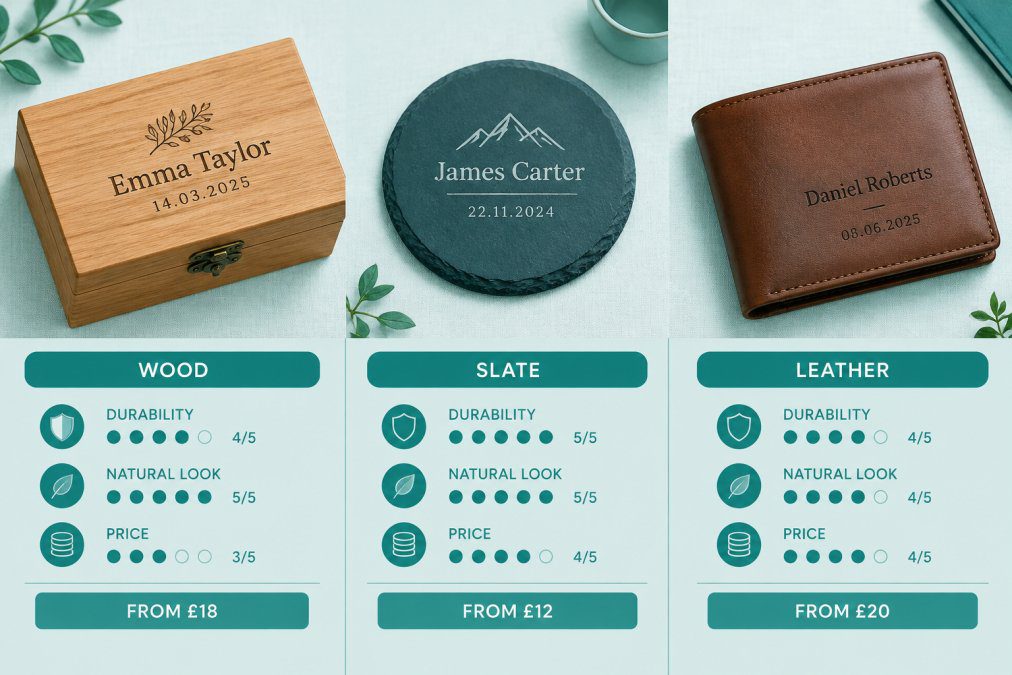
| Material | Durability | Best For | Watch For | Typical price premium over unengraved |
|---|---|---|---|---|
| Wood | Good, ages warmly | Keepsake boxes, signs | Grain can distort fine text | £5-£15 |
| Slate | Excellent, chip risk | Coasters, plaques | Edges need care in transit | £8-£20 |
| Leather | Good, softens with use | Wallets, keyrings | Dark shades hide fine detail | £10-£25 |
| Acrylic | Very good, shatter risk | Modern displays, awards | Can look cheap if thin | £5-£15 |
| Metal | Excellent | Keyrings, tags | Higher cost per item | £12-£30 |
Typical price premium over unengraved
Wood. Laser engraving on wood carbonises the surface, leaving a dark, high-contrast mark. Hardwoods such as oak and walnut hold fine detail better than softwoods, where the grain can pull the laser off line.
Slate. Slate engraves with a pale, chalky mark against the dark surface, which gives excellent legibility even at small sizes. The material is brittle, so a slate coaster dropped on a tiled floor can chip at the edge.
Leather. On leather, the laser removes the top surface to leave a lighter mark. This wears gradually in high-friction areas such as a wallet’s fold or a keyring’s edge.
Acrylic. Acrylic engraves with a frosted white mark that can look sharp and modern. Thin acrylic (under about 3mm) can crack if dropped, and the engraved area can attract dust.
Metal. Stainless steel and aluminium take a permanent mark, often through a fibre laser that changes the surface structure rather than removing material. Metal is the most durable option for everyday carry, which is why keyrings and pet tags are commonly metal.
A common pattern is that the material should follow the item’s handling, not its photograph. If you are comparing options in practice, you can see the personalised slate pieces to judge how the material takes a mark.
Laser Engraving Durability: How Long the Mark Actually Lasts
A properly executed laser engraving on wood, slate, leather or metal will typically outlast the object itself. The mark is not ink sitting on a surface; it is a physical change to the material.
That is the key distinction. Printed decoration can fade with UV exposure and washing. Laser engraving removes or carbonises material, so there is nothing to fade in the usual sense. On metal, the mark is often a permanent change to the surface structure.
Durability does vary by method and material. Shallow surface marking on leather will wear faster in a pocket than a deep cut into slate. For a fuller explanation of how the process works and what affects longevity, our guide to laser engraving services covers the methods in detail.
The practical takeaway: engraving is one of the most durable forms of personalisation available, which is precisely why it suits keepsakes.
When Engraving Is the Wrong Choice
Engraving is permanent, and permanence is a liability when the details might change. Skip it when the recipient’s name, the relationship or the occasion could shift, or when the item is likely to be resold or returned.
Uncertain relationships. A gift for a new partner or a colleague you barely know does not need a name cut into it. A date or a shared joke can feel too intimate before the relationship has settled.
Fast-changing tastes. Children’s gifts with a current favourite character will date quickly. A name alone ages better than a name plus a trend.
Items bought to resell. An engraved item has almost no resale value. Personalised goods can be exempt from the usual right to cancel for online purchases, so check the maker’s returns policy before you order.
High-stakes messages. A quote or declaration you might regret cannot be undone. If you are not certain the words will still feel right in five years, choose a date or a name instead.
Personalisation mistakes. Spelling errors, a wrong date, a message that is too long for the space, or placement that sits awkwardly on the item are the most common reasons an engraved gift disappoints.
Budget and lead time. Engraving adds a price premium, and pricing depends on quantity, dates and delivery; check the SAS Creations website for current prices or a quote. If the occasion is fixed, order early rather than paying a premium for speed.
A recipient-led check. Before you choose engraving, run through five questions: Does the recipient use this kind of item already? Will the message still make sense in ten years? Is the relationship settled enough for a permanent mark? Can you afford the premium without resenting it? And have you confirmed the maker’s returns policy? You can explore personalised gift options that still feel considered without the permanence.
Choosing Your Engraved Keepsake With SAS Creations
The signs that engraved keepsakes are worth it all point the same way: permanence, specificity and material quality. When those three line up, the price premium is easy to justify over a decade of use.
At SAS Creations, we engrave onto wood, slate, acrylic, leather and metal with precision, and we offer vibrant full colour printing. We take on one-off items and short production runs, and turnaround is quick.
If you are ready to choose, you can browse the laser etched gift range and see what suits your recipient.
The real challenge is not finding an engraved gift; it is choosing one the recipient will still value years from now. That takes the right material, a message that ages well, and engraving crisp enough to last. SAS Creations can handle all three, with precision engraving across five materials, full colour printing, and fast turnaround from single pieces to short runs. Get started with SAS Creations and choose a keepsake built to be kept.
Frequently Asked Questions
Are engraved gifts worth the extra cost compared with a standard present?
It depends on whether the item gets used. Customised gifts are often appreciated more than non-customised ones. That premium only holds up when the base item suits the recipient. An engraved item they never touch is a costly ornament; an engraved item they handle daily earns its price back in sentiment.
What should you check before buying an engraved keepsake?
Check four things. First, the base item: will the recipient actually use a slate coaster or a leather wallet? Second, the message length and font choice, since long text shrinks and becomes hard to read. Third, engraving placement, so it does not clash with a clasp or handle. Fourth, the provider’s policy on errors, because engraving cannot be undone. Ask to see previous work in the same material before you commit.
How long does laser engraving last on wood, slate or leather?
Laser engraving removes or carbonises the surface rather than printing on top of it, so it does not flake or wash off. On wood and slate the mark typically outlasts the item itself. Leather wears more gradually as the surface oils and flexes, especially on a wallet carried daily. Metal and acrylic hold a crisp mark well. The main risks are poor engraving depth and soft materials, not the laser process.
Is it better to engrave a name, date or short message?
Dates and initials age best because they stay relevant. A wedding date or a birth date works on almost any item and needs no explanation. Names suit items the recipient keeps at home, such as a keepsake box. Short messages carry the most emotional significance but also the most risk, since a phrase that feels right now can read as odd in ten years. Keep messages under about six words and avoid in-jokes.
